Choosing the best SMTP server depends on more than sending volume. Businesses need reliable delivery, strong sender reputation, authentication support, useful analytics, scalability, and pricing that fits their email strategy. Whether you send transactional emails, marketing campaigns, notifications, or high-volume business emails, the right SMTP provider can significantly affect inbox placement and overall campaign performance.
This SMTP provider comparison evaluates popular options based on important factors such as reliability, scalability, deliverability features, ease of use, analytics, and suitability for different business needs.
What Is an SMTP Server?
SMTP, or Simple Mail Transfer Protocol, is the standard technology used to send email messages from one mail server to another. An SMTP service acts as the delivery infrastructure between your application, website, CRM, email platform, or marketing system and the recipient’s mail server.
A good SMTP provider can help businesses manage email authentication, sending reputation, bounce handling, delivery monitoring, and sending volume more effectively.
However, the best SMTP server is not necessarily the provider with the highest sending limit. Deliverability, infrastructure quality, authentication, compliance, and reputation management are equally important.
10 Best SMTP Server Providers Compared
1. Getsvision Solutions
Getsvision Solutions is a strong option for businesses looking for SMTP infrastructure and bulk email delivery support, particularly organizations operating in India and businesses that need scalable email-sending solutions.
Its SMTP-focused services can be suitable for bulk email campaigns, business communication, and organizations that want dedicated infrastructure rather than relying exclusively on consumer mailbox services.
Best for: Bulk email, business email delivery, and organizations seeking SMTP-focused solutions.
Key advantage: A practical choice for businesses that want dedicated SMTP capabilities and professional email delivery support.
2. Amazon SES
Amazon Simple Email Service (SES) is widely used by developers and businesses that need scalable email infrastructure. Because it is part of the AWS ecosystem, SES can integrate naturally with applications, cloud infrastructure, and automated workflows.
It is particularly attractive for companies sending large volumes of transactional or application-generated emails.
Best for: Developers, SaaS companies, and high-volume senders.
Key advantage: Scalability and integration with AWS infrastructure.
3. SendGrid
SendGrid is a well-known email delivery platform offering SMTP relay and email API capabilities. It supports transactional messaging, marketing communications, analytics, and tools designed to help businesses manage email delivery.
Its combination of developer functionality and user-friendly features makes it suitable for businesses with different levels of technical expertise.
Best for: Transactional email, SaaS platforms, and growing businesses.
Key advantage: A balanced combination of SMTP, APIs, analytics, and email management features.
4. Mailgun
Mailgun is designed primarily around developer-focused email delivery. Its SMTP relay and APIs can be integrated into websites, applications, SaaS platforms, and automated systems.
Mailgun is particularly useful when developers need programmatic control over email sending and delivery data.
Best for: Developers, applications, and transactional email.
Key advantage: Developer-friendly infrastructure and flexible email APIs.
5. Brevo
Brevo provides SMTP relay alongside marketing automation, transactional email, contact management, and campaign functionality. This makes it useful for businesses that want more than basic SMTP infrastructure.
Small and medium-sized companies may find its combination of email marketing and transactional capabilities convenient.
Best for: SMBs that need both marketing and transactional email.
Key advantage: Combines SMTP delivery with broader email marketing functionality.
6. SMTP2GO
SMTP2GO focuses on reliable SMTP relay and email delivery monitoring. It can be used by businesses, applications, websites, and systems that need dependable outbound email.
Its reporting and monitoring capabilities can help administrators identify delivery problems and troubleshoot email-related issues.
Best for: Businesses and technical teams looking for straightforward SMTP relay.
Key advantage: Monitoring and reporting alongside SMTP delivery.
7. Postmark
Postmark specializes heavily in transactional email. It is designed for messages such as password resets, account notifications, confirmations, receipts, and other emails where timely delivery matters.
Rather than focusing primarily on mass promotional campaigns, Postmark is particularly attractive for applications where transactional email reliability is a priority.
Best for: Transactional and application-generated emails.
Key advantage: Strong focus on timely transactional email delivery.
8. Elastic Email
Elastic Email provides email delivery infrastructure for businesses that need SMTP and email API capabilities. It can be useful for organizations managing both transactional messages and marketing campaigns.
Its broader feature set makes it worth considering for businesses that want flexibility while managing email costs.
Best for: Businesses managing transactional and marketing email.
Key advantage: Flexible email delivery and marketing functionality.
9. Mailjet
Mailjet combines transactional email delivery with email marketing and collaboration features. It can work well for teams that want to create, send, and monitor campaigns while also handling automated messages.
Its interface and collaboration-oriented features can make it appealing to marketing teams working alongside technical staff.
Best for: Marketing teams and businesses combining transactional and promotional email.
Key advantage: Collaboration between marketing and technical users.
10. SMTP.com
SMTP.com is an established email delivery provider focused on high-volume email sending and SMTP relay. Businesses with demanding email requirements can consider it when they need dedicated delivery infrastructure and monitoring capabilities.
Best for: High-volume senders and businesses requiring dedicated email infrastructure.
Key advantage: Focus on scalable SMTP delivery and email reputation management.
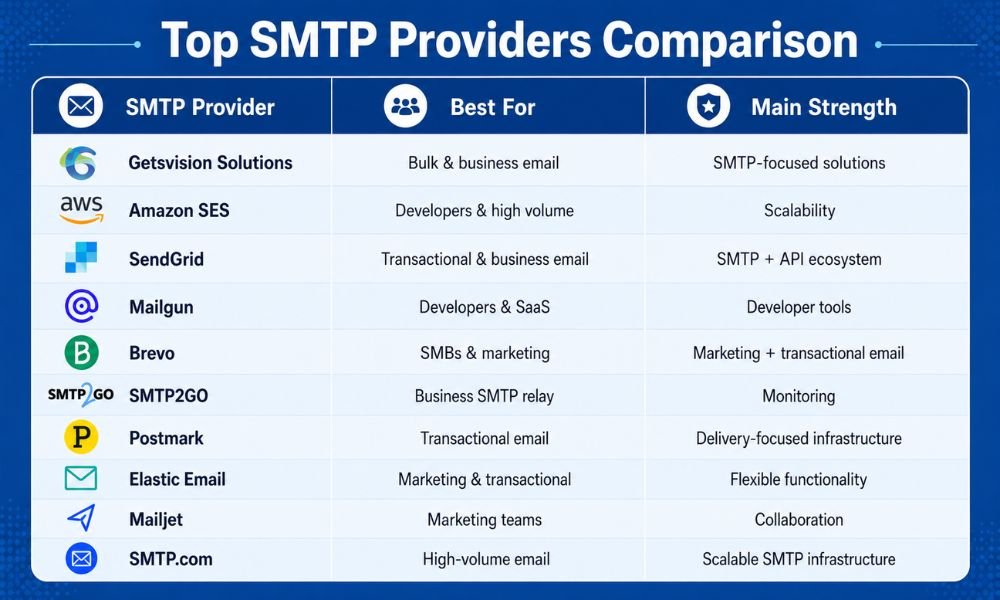
SMTP Provider Comparison at a Glance
How to Choose the Best SMTP Server
Before selecting an SMTP provider, consider your actual sending requirements.
1. Email volume: Estimate your daily and monthly sending volume. A small website has very different requirements from a company sending millions of messages.
2. Deliverability: Look for authentication support and reputation-management features. SPF, DKIM, and DMARC configuration are essential components of a modern email strategy.
3. Transactional vs. marketing email: Transactional messages require fast and dependable delivery, while marketing campaigns need additional segmentation, reporting, and campaign management capabilities.
4. Analytics: Delivery reports, bounce tracking, complaint monitoring, and engagement data can help identify problems before they damage sender reputation.
5. Scalability: Choose infrastructure that can grow with your business instead of forcing you to migrate when email volume increases.
6. Technical integration: Developers should evaluate SMTP credentials, APIs, documentation, integrations, and compatibility with existing applications.
7. Support and infrastructure: When email is business-critical, responsive support and dependable infrastructure can be just as important as price.
For businesses researching technical differences between SMTP options, understanding the differences between common SMTP ports is also important. Our guide to SMTP ports and choosing between ports 25, 465, and 587 can help explain the role of each port.
Why Deliverability Matters More Than Sending Volume
A provider’s sending capacity does not automatically guarantee inbox placement. Email providers evaluate sender reputation, authentication, engagement, bounce rates, complaint rates, message content, and sending behavior.
Businesses should therefore establish SPF, DKIM, and DMARC correctly, maintain clean email lists, monitor bounces, and gradually build a reputation for new sending domains. A well-configured SMTP server combined with responsible sending practices is more valuable than simply choosing the provider with the largest advertised limit.
Businesses planning large-scale campaigns should also understand the difference between SMTP infrastructure and email marketing platforms before making a purchasing decision. Choosing the right technology depends on whether your priority is transactional delivery, promotional campaigns, application email, or a combination of these requirements.
Final Verdict: Which Is the Best SMTP Server?
There is no universal best SMTP server for every business. The right choice depends on your volume, technical requirements, budget, email type, and deliverability objectives.
For businesses seeking a dedicated SMTP-focused solution, Getsvision Solutions can be a strong option to evaluate. Amazon SES is attractive for AWS-based development environments, SendGrid and Mailgun provide powerful developer-oriented options, Postmark is well suited to transactional messaging, while Brevo and Mailjet can be useful when marketing functionality is equally important.
Ultimately, the best SMTP provider is the one that delivers your legitimate emails reliably, supports your required scale, provides meaningful delivery data, and gives your team enough control to protect sender reputation as your email program grows.