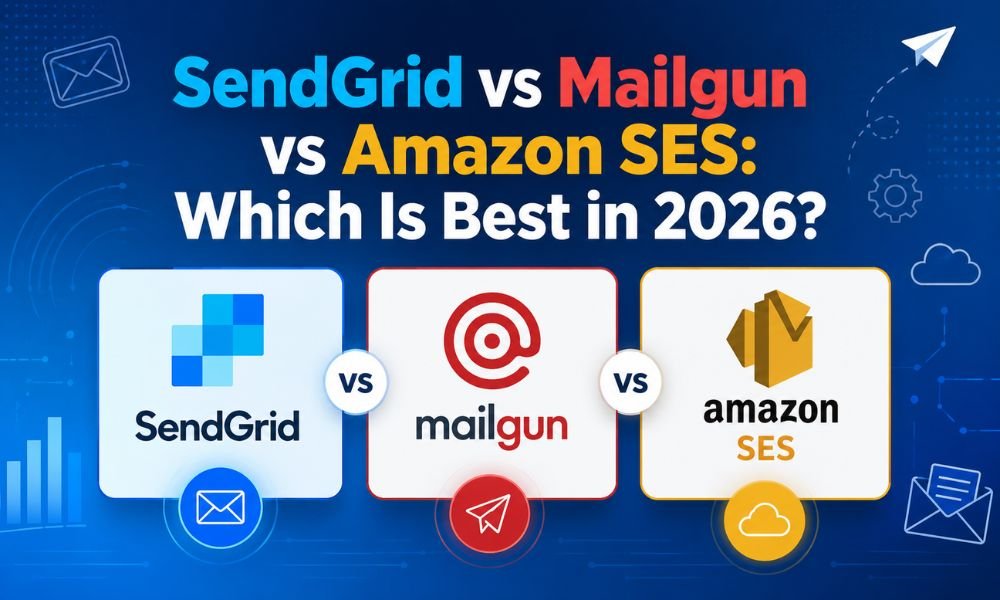
Choosing the right email delivery platform can directly affect your website’s deliverability, transactional emails, customer communication, and marketing performance. Among the most popular options, SendGrid, Mailgun, and Amazon SES remain strong choices in 2026—but they are designed for slightly different types of users.
If you are comparing these three platforms for transactional emails, bulk sending, WordPress, SaaS applications, e-commerce, or large-scale email campaigns, the best option depends on your budget, technical expertise, sending volume, analytics requirements, and deliverability needs.
This guide compares SendGrid vs Mailgun vs Amazon SES so you can choose the right email service for your business.
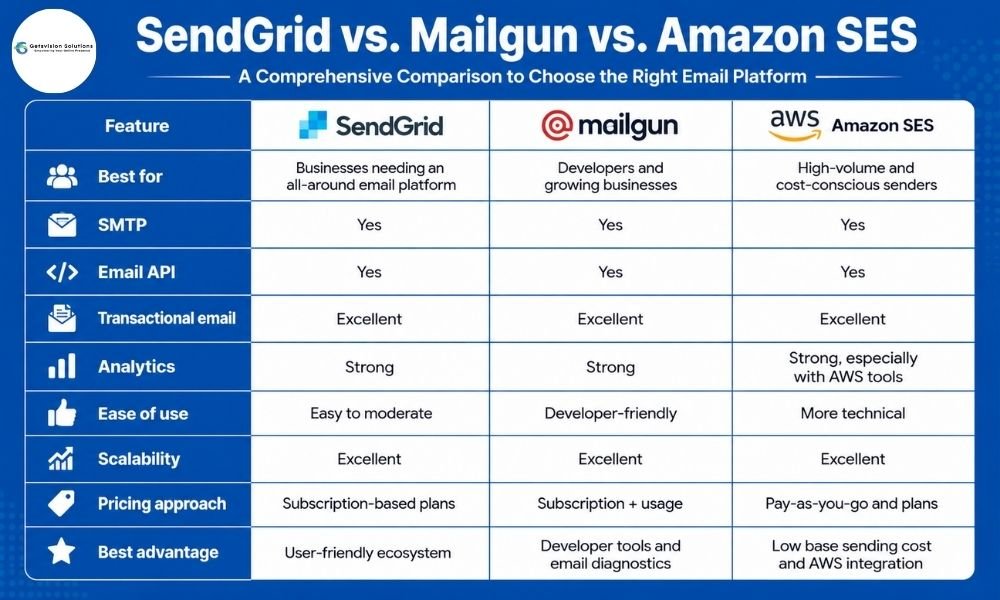
SendGrid vs Mailgun vs Amazon SES: Quick Comparison
What Is SendGrid?
Twilio SendGrid is a widely used cloud email platform for transactional and marketing email. It provides both SMTP and API-based sending, making it suitable for websites, applications, SaaS platforms, online stores, and businesses that need a relatively straightforward email infrastructure.
SendGrid currently separates its offerings into Email API and Marketing Campaigns, allowing businesses to choose between application-driven email delivery and campaign-oriented functionality.
Its Email API pricing includes plans such as Essentials and Pro. Current published pricing shows, for example, an Essentials plan at $19.95/month for 50,000 emails, while higher-volume plans are available as sending requirements increase.
SendGrid advantages
- Simple SMTP and API integration
- Transactional and marketing email capabilities
- Strong reporting and analytics
- Suitable for businesses that don’t want to build everything around AWS
- Large ecosystem and documentation
- Good option for teams that value ease of implementation
SendGrid disadvantages
SendGrid can become comparatively expensive as your email volume increases. In addition, its current Email API plans have sending-limit policies, so businesses should review their plan limits before choosing it for rapidly growing workloads. SendGrid states that, beginning March 26, 2026, Email API Essentials and Pro accounts are subject to a monthly sending cap of 10× the plan’s included allotment.
Best for: Startups, SaaS companies, agencies, e-commerce businesses, and organizations wanting an established email platform with both developer and marketing capabilities.
What Is Mailgun?
Mailgun is an email delivery platform strongly focused on developers and businesses that need reliable transactional email infrastructure. It supports both RESTful APIs and SMTP relay, making it flexible for applications, websites, and automated email systems.
Mailgun’s current plans include Free, Basic, Foundation, and Scale. The Foundation plan is currently listed at $35/month for 50,000 emails, while Scale starts at $90/month for 100,000 emails.
Mailgun also provides tools for email analytics, webhooks, inbound routing, email validation, suppression management, authentication, and deliverability monitoring.
Mailgun advantages
- Developer-focused API
- SMTP relay support
- Detailed email logs and analytics
- Webhooks for application events
- Strong transactional email functionality
- Email validation and deliverability tools
- Useful inbound email routing features
- Flexible scaling for growing applications
Mailgun also offers deliverability-focused products that can provide inbox placement testing, blocklist monitoring, spam-trap monitoring, and integrations with services such as Google Postmaster Tools.
Mailgun disadvantages
Mailgun is not necessarily the cheapest choice for every workload. Its pricing can become more complex when you add validations, overages, dedicated IPs, or advanced deliverability products.
Best for: Developers, SaaS companies, agencies, online applications, and businesses that want detailed control over their email infrastructure.
What Is Amazon SES?
Amazon Simple Email Service (SES) is AWS’s cloud-based email service. It is particularly attractive to companies already using AWS and organizations sending large quantities of email.
Historically, SES has been known for its low pay-as-you-go pricing. In 2026, AWS introduced a new pricing structure with Essentials, Pro, and Enterprise plans while retaining à-la-carte pricing.
Under current à-la-carte pricing, outbound email starts at $0.10 per 1,000 emails, excluding applicable additional charges. AWS’s new Essentials plan is currently priced at $0.16 per 1,000 emails for the first 10 million emails/month, with lower marginal rates at higher volumes.
This makes SES particularly attractive when sending volume is high and infrastructure costs matter.
Amazon SES advantages
- Very competitive sending costs
- Excellent scalability
- Strong AWS integration
- SMTP and API support
- Detailed configuration options
- Suitable for large transactional workloads
- Useful for developers and technical teams
- New 2026 plans provide additional deliverability capabilities
AWS’s new SES plans also provide progressively more features. Pro includes capabilities such as managed dedicated IPs, email validation, and global deliverability visibility, while Enterprise adds features including multi-region resilience and reputation isolation.
Amazon SES disadvantages
The biggest drawback for beginners is complexity. SES is powerful, but configuring identities, DNS authentication, AWS permissions, reputation controls, monitoring, and production sending can require more technical knowledge than platforms such as SendGrid.
SES also operates with sending quotas. New accounts begin in a sandbox with restrictions, and production sending limits depend on the account and use case.
Best for: High-volume senders, AWS-based businesses, developers, SaaS platforms, enterprises, and companies prioritizing infrastructure cost efficiency.
Which Is Best for Email Deliverability?
No provider can guarantee that every email reaches the inbox. Deliverability depends on sender reputation, authentication, engagement, bounce rates, complaint rates, list quality, content, infrastructure, and recipient-provider policies.
All three platforms can support important authentication standards such as SPF, DKIM, and DMARC, but your configuration and sending practices remain critical.
Before selecting a provider, businesses should understand the fundamentals of SPF, DKIM, and DMARC and establish a clean sending process.
For high-volume campaigns, gradually building sender reputation is equally important. A sudden increase in volume can hurt deliverability even when your SMTP provider itself has a strong reputation.
SendGrid vs Mailgun vs Amazon SES for WordPress
For WordPress websites, the best choice depends on how much technical work you want to handle.
SendGrid and Mailgun can be convenient because many WordPress SMTP solutions can connect to third-party email providers through SMTP or APIs.
Amazon SES can also work extremely well with WordPress, particularly when cost and scalability are priorities, but setup may require more AWS configuration.
If your WordPress website is experiencing delivery problems, simply changing the SMTP provider may not solve the underlying issue. Authentication, DNS records, hosting configuration, plugin settings, and server restrictions should also be checked.
For WordPress administrators, understanding the available SMTP plugins for WordPress can help determine the most practical setup.
Which Is Cheapest in 2026?
For pure sending cost, Amazon SES generally has the strongest cost advantage, especially at substantial volumes.
For example, AWS currently lists à-la-carte outbound email at $0.10 per 1,000 emails.
Mailgun’s Foundation plan currently starts at $35/month for 50,000 emails, while SendGrid’s published Email API Essentials pricing starts at $19.95/month for 50,000 emails.
However, price should not be the only deciding factor. A cheaper email provider can become expensive if your team spends significant time troubleshooting infrastructure, deliverability, monitoring, or integrations.
Which Is Easiest to Use?
For businesses wanting a more packaged experience, SendGrid is a strong choice.
For developers who want detailed email APIs, logs, webhooks, routing, and infrastructure controls, Mailgun is highly competitive.
For technical teams already operating inside AWS, Amazon SES can be the most logical option because it integrates naturally with the broader AWS ecosystem.
Therefore, the “easiest” provider depends on your existing technology stack.
Which Should You Choose?
Choose SendGrid if:
- You want an established all-in-one email platform.
- Your team values usability.
- You need both transactional and marketing capabilities.
- You want straightforward API and SMTP integration.
- You prefer a subscription-style pricing structure.
Choose Mailgun if:
- Your business is developer-focused.
- Transactional email is a major requirement.
- You need powerful APIs and webhooks.
- Detailed email logs and analytics matter.
- You want additional deliverability and validation tools.
Choose Amazon SES if:
- You send hundreds of thousands or millions of emails.
- Email infrastructure cost is a major concern.
- You already use AWS.
- You have developers or technical resources available.
- You need highly scalable email infrastructure.
Final Verdict: SendGrid vs Mailgun vs Amazon SES
There is no universal winner.
Amazon SES is the best choice for cost-conscious, high-volume and AWS-centric businesses. Its 2026 pricing changes make the platform more feature-rich while preserving a strong cost advantage for many high-volume workloads.
Mailgun is arguably the best middle ground for developers who want strong APIs, SMTP, analytics, webhooks, routing, and deliverability-focused tools without building their entire email infrastructure around AWS.
SendGrid is a strong choice for businesses looking for a mature, approachable email platform with both transactional and marketing capabilities.
Ultimately, choose the service based on your sending volume, technical resources, required integrations, deliverability strategy, and total cost of ownership—not simply the advertised price per 1,000 emails.
For most small businesses, startups, and WordPress websites, ease of setup and reliable delivery may matter more than saving a few dollars. For large SaaS platforms and high-volume senders, however, infrastructure economics and scalability can make Amazon SES particularly compelling in 2026.