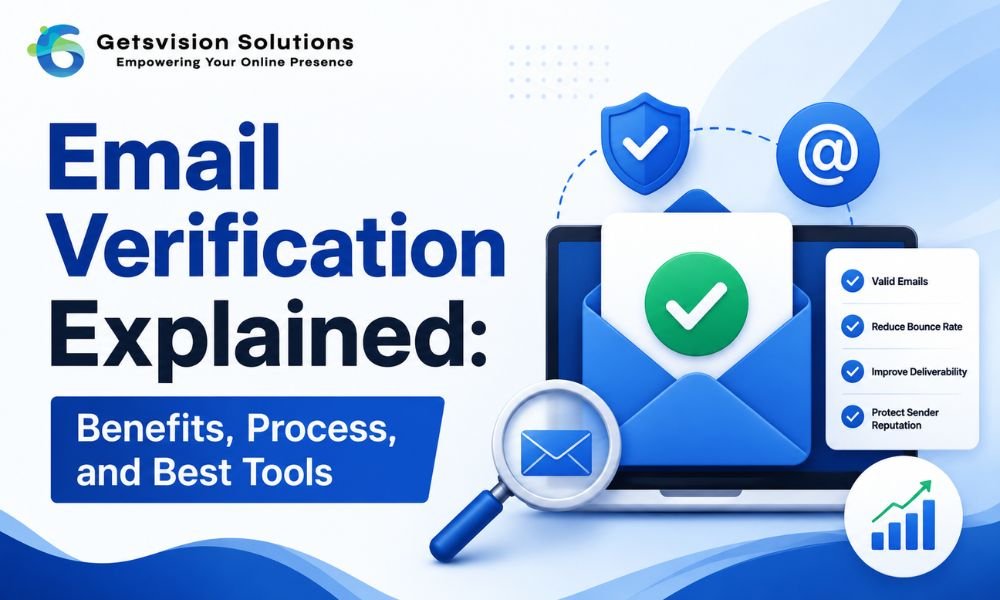
Email verification is an important step for businesses that rely on email marketing, sales outreach, newsletters, or transactional communication. Sending campaigns to an unverified list can result in bounced emails, poor engagement, wasted marketing spend, and damage to your sender reputation.
But email verification is more than simply checking whether an email address contains an “@” symbol. A reliable verification process examines several signals to determine whether an address is likely to receive email safely.
In this guide, we’ll explain what email verification is, how it works, why it matters, and what to look for when choosing an email verification tool.
What Is Email Verification?
Email verification is the process of evaluating an email address to determine whether it is properly formatted, associated with a valid domain, and potentially deliverable.
Depending on the verification service, checks may include:
- Syntax and formatting validation
- Domain and DNS verification
- MX record checking
- Mailbox availability checks
- Disposable email detection
- Role-based address detection
- Catch-all domain identification
- Spam-trap and risky-address detection
- Duplicate and invalid address identification
It’s important to understand that verification doesn’t guarantee that a recipient will open, read, or respond to an email. Instead, it helps businesses identify addresses that may create unnecessary delivery risks before sending a campaign.
Why Is Email Verification Important?
A large email database isn’t necessarily a valuable email database. If a significant percentage of your contacts are outdated, invalid, duplicated, or risky, your campaign performance can suffer.
1. Reduce Email Bounces
Invalid or inactive addresses can generate hard bounces. Regular verification helps identify problematic addresses before you send a large campaign.
A cleaner list can make your campaign reporting more meaningful because your engagement metrics aren’t being distorted by large numbers of undeliverable addresses.
2. Protect Sender Reputation
Internet service providers and mailbox providers consider various signals when evaluating email traffic. Consistently sending to invalid or unwanted addresses can contribute to poor sending performance.
Email verification is therefore one part of a broader deliverability strategy. It should work alongside good consent practices, authentication, list hygiene, relevant content, and responsible sending behavior.
3. Improve Marketing Efficiency
Why pay to send thousands of emails to addresses that are unlikely to receive them?
Removing invalid contacts can help businesses use their email platform, SMTP infrastructure, or marketing budget more efficiently.
4. Improve Data Quality
Email verification can also improve the quality of your customer database. Removing obvious errors and risky addresses makes segmentation, reporting, lead management, and campaign analysis more useful.
5. Improve Campaign Analytics
Suppose a campaign is sent to 50,000 contacts, but 5,000 addresses are invalid. Your results may look worse than they actually are.
With a cleaner list, metrics such as delivery rate, click-through rate, conversion rate, and engagement can provide a more realistic picture of campaign performance.
How Does Email Verification Work?
A professional email verification process generally involves several stages.
Step 1: Syntax Check
The system first checks whether the email address follows an acceptable format.
For example, it can detect obvious problems such as:
- Missing @ symbols
- Invalid characters
- Incorrect formatting
- Incomplete domains
This is the simplest layer of verification.
Step 2: Domain Verification
The verification system checks whether the domain exists and whether its DNS configuration indicates that it can receive email.
An address associated with a nonexistent domain is unlikely to be deliverable.
Step 3: MX Record Check
Mail Exchange (MX) records tell sending systems which servers are responsible for receiving email for a domain.
A verifier can inspect these records to identify whether the domain has an email receiving infrastructure.
Step 4: Mailbox-Level Checks
Some verification services perform additional checks to determine whether a mailbox appears to exist.
However, mailbox validation is not always definitive. Different mail servers use different configurations, and some domains intentionally restrict verification attempts.
Step 5: Risk Detection
Advanced verification platforms may identify addresses or domains associated with higher risk, including disposable addresses, role-based accounts, catch-all domains, or other problematic categories.
The exact checks vary between providers, so businesses should understand what a tool actually verifies rather than relying only on a percentage-based accuracy claim.
When Should You Verify an Email List?
Email verification shouldn’t necessarily be a one-time activity.
Consider verification when:
- You have imported an old contact database.
- You collected leads from multiple sources.
- Your bounce rate has increased unexpectedly.
- You haven’t emailed your audience for a long period.
- You’re preparing a large campaign.
- Your CRM contains outdated contacts.
- You’re moving contacts between marketing platforms.
- You’re collecting leads through multiple forms or integrations.
For continuously growing databases, real-time verification at the point of signup can also help prevent obviously invalid or disposable addresses from entering your system.
Bulk Verification vs Real-Time Verification
There are two common approaches.
Bulk Email Verification
Bulk verification is useful when you already have a large database that needs cleaning.
You typically upload a CSV or another supported file, allow the service to process the addresses, and then review or export the results.
This is particularly useful before a major marketing campaign or when cleaning an old CRM.
Real-Time Email Verification
Real-time verification happens when a user submits an email address through a website form, application, or other system.
An API can evaluate the address before it enters your database.
For businesses receiving large numbers of registrations or leads, real-time verification can reduce the number of poor-quality addresses entering the system in the first place.
How to Choose the Best Email Verification Tool
There isn’t one verification platform that is automatically best for every business.
Before choosing a service, evaluate:
- Verification depth: What checks does the platform actually perform?
- Accuracy: How does it classify uncertain or risky addresses?
- API availability: Can you connect verification to your website or application?
- Bulk processing: Can it handle your database size?
- Integrations: Does it work with your CRM or email marketing platform?
- Reporting: Can you understand why addresses were classified as risky?
- Data security: How does the provider handle uploaded contact information?
- Pricing: Are you paying for credits, volume, subscriptions, or another model?
- Support: Can you get assistance when verification results are unclear?
Don’t select a provider based solely on a headline accuracy percentage. Look at the actual verification process, data handling, integrations, pricing structure, and how uncertain results are categorized.
Email Verification Is Not the Same as Email Deliverability
This distinction is important.
Email verification helps determine whether an address appears valid or potentially deliverable.
Email deliverability is the broader ability of your messages to reach recipients’ inboxes rather than spam folders or other filtered locations.
You can have a clean email list and still experience deliverability problems because of factors such as sender reputation, authentication, message content, recipient engagement, sending behavior, or technical configuration.
That’s why verification should be treated as one component of a complete email infrastructure and marketing strategy.
For businesses comparing different ways to send large volumes of email, understanding the difference between SMTP infrastructure and email APIs is also valuable.
Common Email Verification Mistakes to Avoid
Even businesses using verification tools can make mistakes.
Avoid these common practices:
- Buying random email lists
- Treating verification as a guarantee of inbox placement
- Ignoring inactive subscribers indefinitely
- Sending campaigns without monitoring bounce rates
- Removing every “unknown” result without understanding why it was classified that way
- Using verification as a substitute for permission-based email marketing
- Assuming one verification check will keep a database clean forever
The goal isn’t simply to have a large list. The goal is to maintain a healthy, permission-based, useful, and deliverable audience.
Final Thoughts
Email verification is a practical part of modern email marketing and communication infrastructure. By checking addresses before sending, businesses can reduce avoidable bounces, improve database quality, make campaign reporting more meaningful, and reduce unnecessary sending costs.
However, verification alone doesn’t guarantee successful email delivery. Strong results require a combination of clean data, responsible list-building, authentication, appropriate sending practices, relevant content, monitoring, and a reliable email delivery infrastructure.
If your business sends email at scale, make verification part of your regular workflow rather than treating it as a one-time cleanup task. A clean list gives your marketing and sales teams better data—and gives your email infrastructure a healthier foundation for long-term performance.