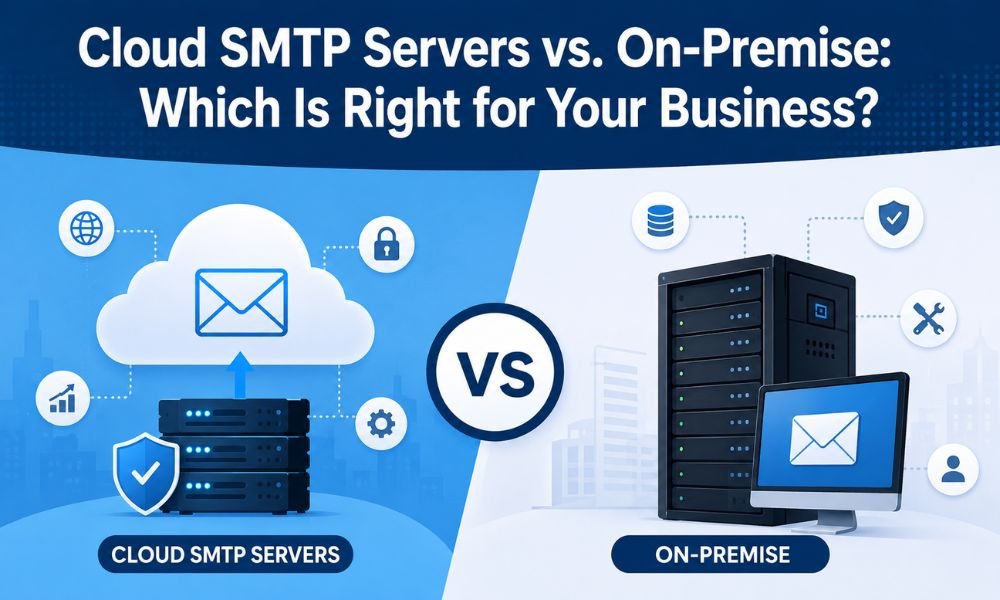
Choosing the right SMTP infrastructure can have a direct impact on email deliverability, security, scalability, cost, and day-to-day IT operations. For businesses that rely on transactional emails, customer communication, notifications, or email marketing, the decision often comes down to two approaches: cloud SMTP servers or on-premise SMTP infrastructure.
Both options can support reliable email delivery, but they solve different business needs. Cloud SMTP is generally easier to deploy and scale, while on-premise SMTP provides greater control over infrastructure, data, and configuration. The right choice depends on your email volume, technical resources, compliance requirements, budget, and long-term growth plans.
This guide compares cloud SMTP servers and on-premise SMTP solutions to help you make a practical, informed decision.
What Is a Cloud SMTP Server?
A cloud SMTP server is an email-sending infrastructure hosted and managed by a third-party provider. Instead of purchasing and maintaining physical servers, your business connects its applications, website, CRM, or email marketing platform to the provider’s SMTP service.
The provider typically manages server infrastructure, network availability, maintenance, monitoring, and much of the technical work involved in keeping the service operational.
Cloud SMTP can be particularly useful for startups, SaaS companies, e-commerce businesses, and growing organizations that need dependable email delivery without building an internal mail infrastructure.
Before selecting a provider, businesses should understand how SMTP authentication, encryption, and ports work. A practical resource on SMTP ports and choosing between 25, 465, and 587 can help teams understand the technical side of SMTP connectivity.
What Is an On-Premise SMTP Server?
An on-premise SMTP server is hosted within your organization’s own physical or private infrastructure. Your IT team is responsible for deploying the server, configuring DNS and authentication records, monitoring performance, managing security, applying updates, and maintaining its reputation with receiving mail providers.
This approach gives organizations significant control over how email is processed and delivered. It can be attractive to businesses with strict data governance policies, specialized infrastructure requirements, or dedicated IT and email-delivery teams.
However, greater control also means greater responsibility. Your business must handle server uptime, IP reputation, security, backup procedures, redundancy, monitoring, troubleshooting, and capacity planning.
Cloud SMTP vs. On-Premise SMTP: Key Differences
1. Cost
Cloud SMTP generally has a lower initial cost because there is no need to purchase physical servers or build a dedicated email infrastructure. Most providers use subscription, usage-based, or volume-based pricing.
On-premise SMTP can require considerable upfront investment in hardware, networking, software, security, backup systems, and technical staff. There are also ongoing costs for maintenance, upgrades, electricity, hosting facilities, and infrastructure management.
For smaller businesses, cloud SMTP is often financially easier to justify because expenses can scale with usage.
2. Scalability
Scalability is one of the biggest advantages of cloud SMTP.
If your business suddenly needs to send significantly more email, a cloud provider can generally offer additional capacity without requiring you to purchase and configure new hardware.
On-premise infrastructure requires advance planning. Increasing email volume may require additional servers, IP addresses, bandwidth, storage, and monitoring capacity.
For rapidly growing companies, cloud SMTP can therefore provide greater operational flexibility.
3. Reliability and Uptime
Cloud SMTP providers typically operate specialized infrastructure designed for high availability. They may use redundant systems, monitoring, multiple servers, and established delivery networks.
With on-premise SMTP, reliability depends heavily on your own infrastructure and IT team. Hardware failures, network outages, configuration problems, or insufficient redundancy can interrupt email delivery.
Organizations that operate their own servers should therefore consider whether they have the resources to maintain reliable service around the clock.
4. Security and Data Control
On-premise SMTP provides direct control over server configuration, access policies, logs, and data handling. This can be important for organizations with specific internal security requirements.
Cloud SMTP providers, meanwhile, are responsible for securing their infrastructure, while customers remain responsible for account credentials, application configuration, access controls, and appropriate data handling.
The key question is not simply whether cloud or on-premise is “more secure.” Businesses should evaluate the provider’s security practices, authentication options, encryption, access controls, compliance capabilities, monitoring, and incident-response procedures.
5. Email Deliverability
Having control over an SMTP server does not automatically guarantee strong deliverability.
Whether you use cloud or on-premise infrastructure, successful email delivery depends on factors such as IP reputation, domain reputation, authentication, bounce rates, spam complaints, message quality, recipient engagement, and sending behavior.
Businesses should properly configure SPF, DKIM, and DMARC and monitor delivery performance. They should also maintain clean mailing lists and avoid sending unsolicited messages.
For businesses managing high-volume campaigns, understanding how to select infrastructure based on sending requirements is essential. A useful guide to choosing the right SMTP server for bulk email campaigns can provide additional context.
Advantages of Cloud SMTP
Cloud SMTP can be a strong option when a company wants:
- Fast deployment without purchasing hardware
- Easy scalability as email volume increases
- Lower infrastructure management requirements
- Professional monitoring and support
- Predictable operational costs
- Integration with websites, applications, CRMs, and marketing platforms
- Reduced responsibility for maintaining physical infrastructure
For many small and medium-sized businesses, these advantages make cloud SMTP the more practical starting point.
Advantages of On-Premise SMTP
On-premise SMTP can make sense when an organization requires:
- Maximum control over infrastructure
- Greater control over data processing
- Customized server configurations
- Integration with existing internal systems
- Specialized compliance or governance requirements
- An experienced IT team capable of managing email infrastructure
- Predictable control over dedicated resources
However, businesses should not choose on-premise infrastructure solely because it appears more professional or secure. The additional control comes with significant operational responsibilities.
Which SMTP Solution Is Better for Your Business?
The answer depends on your business model and resources.
Choose cloud SMTP if you are a startup, small business, SaaS company, e-commerce brand, or growing organization that values quick deployment, scalability, and reduced infrastructure management.
Consider on-premise SMTP if your organization has specialized infrastructure requirements, strict internal controls, substantial technical expertise, and a clear business reason to maintain its own email infrastructure.
For many organizations, a hybrid approach can also be worth considering. Critical transactional emails might use one infrastructure while internal or specialized messaging uses another. This can provide flexibility while reducing dependency on a single system.
Questions to Ask Before Choosing
Before investing in an SMTP solution, evaluate:
- How many emails do you send each month?
- Are your emails transactional, marketing-focused, or both?
- How quickly is your email volume expected to grow?
- Do you have experienced IT staff to manage SMTP infrastructure?
- What are your security and compliance requirements?
- Can you continuously monitor bounce rates and delivery performance?
- Do you need dedicated IP infrastructure?
- What is your realistic infrastructure budget?
- How important are automated scaling and managed support?
- Can your team maintain domain and IP reputation over time?
Answering these questions will usually make the decision much clearer.
Final Verdict: Cloud or On-Premise SMTP?
For most modern businesses, cloud SMTP is the more convenient and scalable option. It reduces infrastructure complexity while allowing businesses to increase email capacity as they grow.
On-premise SMTP remains valuable for organizations that need extensive control and have the technical resources to manage their own infrastructure. However, that control comes with higher maintenance requirements and greater responsibility for security, uptime, reputation, and deliverability.
Ultimately, the best SMTP solution is not necessarily the one with the most features. It is the one that matches your email volume, technical capabilities, security requirements, budget, scalability needs, and deliverability goals.
Before making a decision, calculate the total cost of ownership—not just the server or subscription price. Consider maintenance, monitoring, staffing, security, infrastructure upgrades, reputation management, and the potential business cost of unreliable email delivery. A solution that is slightly more expensive but consistently delivers important messages can provide significantly greater value over time.