Search is changing quickly in 2026. People are no longer relying only on traditional Google search results to find information. They are also using AI-powered search experiences, conversational tools, and answer engines to research products, compare services, solve problems, and make purchasing decisions.
That shift has made three terms increasingly important for marketers and website owners: SEO, AEO, and GEO.
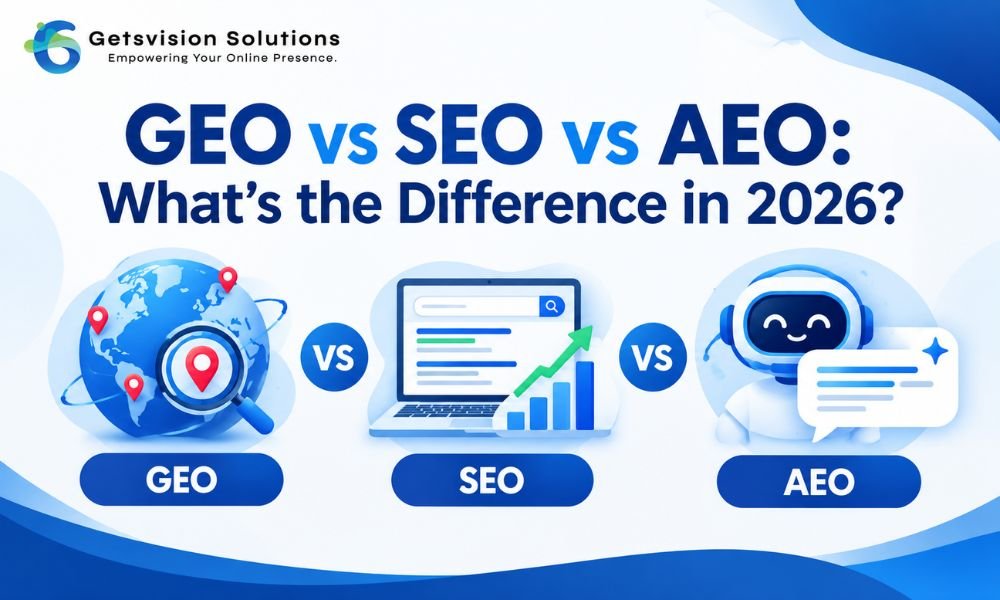
Although these strategies overlap, they are not exactly the same. SEO focuses on visibility in traditional search engines, AEO focuses on earning visibility when users ask questions and expect direct answers, while GEO focuses on making content more useful and discoverable within generative AI search experiences.
Understanding the difference can help businesses create a search strategy that works across both traditional and AI-driven discovery.
What Is SEO?
SEO, or Search Engine Optimization, is the practice of improving a website so search engines can crawl, understand, index, and potentially rank its content for relevant searches.
Traditional SEO covers areas such as:
- Keyword and search-intent research
- High-quality content creation
- Internal linking
- Technical SEO
- Website structure
- Page experience
- Mobile usability
- Search-friendly titles and headings
- Authority and relevant external references
The goal is not simply to insert keywords into a page. Modern SEO is about creating useful content that satisfies the user’s reason for searching.
Google’s current Search guidance emphasizes helpful, reliable, people-first content rather than content created primarily to manipulate rankings. Google also specifically advises creators to demonstrate experience, expertise, authoritativeness, and trustworthiness where appropriate.
For example, if someone searches “how to improve technical SEO,” an effective SEO page should not merely define technical SEO. It should explain the important issues, provide practical steps, examples, and enough context for the reader to solve the problem.
For businesses, SEO remains the foundation because strong technical accessibility, relevant content, internal linking, and overall site quality also support visibility in newer search experiences.
What Is AEO?
AEO stands for Answer Engine Optimization.
AEO focuses on making content easy for search systems and answer engines to understand and use when responding to specific questions.
Instead of targeting only a keyword such as:
“SEO strategy”
an AEO-focused page might address questions such as:
- What is SEO?
- How does SEO work?
- What is the difference between SEO and AEO?
- Is AEO replacing SEO?
- How can a business optimize content for AI search?
The underlying goal is to provide clear, concise, directly useful answers.
This makes content structure particularly important. Well-organized headings, short explanatory sections, definitions, lists, comparisons, and logically connected information can make a page easier for both users and search systems to understand.
However, AEO should not be treated as a completely separate replacement for SEO. Google’s current guidance for AI search states that the same foundational SEO practices used for Google Search remain relevant for AI features such as AI Overviews and AI Mode.
What Is GEO?
GEO stands for Generative Engine Optimization.
GEO is generally used to describe optimizing content for generative AI systems and AI-powered search experiences that generate responses rather than simply displaying a traditional list of blue links.
These experiences may synthesize information from multiple sources and provide users with a conversational response.
GEO therefore places additional emphasis on creating content that is:
- Original
- Useful
- Reliable
- Clearly structured
- Contextually relevant
- Supported by genuine expertise or experience
- Valuable enough to be referenced or surfaced in AI-generated responses
Google’s 2026 guidance on generative AI search emphasizes creating unique, non-commodity content and bringing original viewpoints and first-hand experience rather than simply rewriting information that already exists online.
That is an important distinction.
Simply producing hundreds of AI-generated articles around slightly different keyword variations is not a sustainable GEO strategy. Google specifically warns against creating large amounts of content primarily to manipulate rankings or generative AI responses.
GEO vs SEO vs AEO: Key Differences
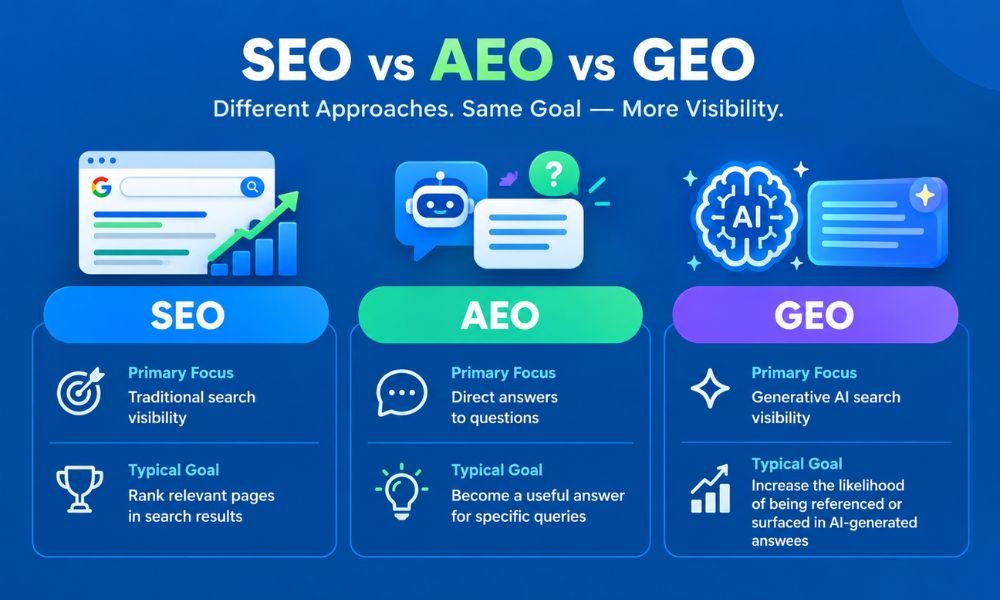
The three strategies should not be treated as competing approaches.
Instead, they work together.
SEO provides the foundation. AEO improves answer-focused content. GEO expands the strategy toward generative search experiences.
Does GEO Replace SEO in 2026?
No.
This is one of the biggest misconceptions surrounding AI search.
Google’s documentation states that pages appearing in AI Overviews or AI Mode still need to meet the normal technical requirements for Google Search and be eligible to appear with a snippet. Google also says there are no additional technical requirements specifically required to appear in these AI features.
That means businesses should not abandon traditional SEO and chase every new GEO tactic.
Instead, strengthen the fundamentals.
A technically accessible website with helpful content, logical internal linking, strong page experience, clear information architecture, and trustworthy information gives both users and search systems a better understanding of the site.
For example, improving your technical SEO strategy and Google Search Console knowledge can help you identify indexing, performance, and search visibility issues that may affect your website more broadly.
How E-E-A-T Fits Into SEO, AEO, and GEO
E-E-A-T stands for Experience, Expertise, Authoritativeness, and Trustworthiness.
It is important to understand that Google does not describe E-E-A-T itself as a single ranking factor. Instead, Google uses a variety of signals and systems that can help identify content demonstrating these qualities. Trust is particularly important.
For a business website, E-E-A-T can be demonstrated through:
- Accurate author information
- Relevant professional experience
- Original research or analysis
- First-hand examples
- Transparent claims
- Reliable sources
- Updated information
- Clear business information
- Helpful supporting resources
This matters for GEO and AEO because AI-driven systems need useful information to synthesize into answers. Content that simply repeats generic information provides little reason to stand out.
For example, instead of writing another generic article about “SEO best practices,” a digital marketing company could share its practical observations, explain common implementation mistakes, provide examples, and show how specific SEO problems were diagnosed and resolved.
That creates substantially more value for the reader.
How to Optimize for SEO, AEO, and GEO Together
The most effective approach in 2026 is to create one strong content strategy rather than three completely separate strategies.
Start with search intent.
Ask what the user actually wants to accomplish. Then create content that solves that problem comprehensively.
Next, structure the page clearly. Use descriptive headings, concise answers, examples, comparison tables where useful, and natural language.
Then strengthen the content with genuine experience and original insights.
Your internal linking should also help users discover related information rather than simply adding links for SEO purposes. For example, a page about search visibility can naturally connect to your guide on site architecture and URL structure best practices for SEO.
Finally, make sure the page is technically accessible, indexable, fast enough for users, mobile-friendly, and easy to navigate.
The Future of Search Is Not SEO vs GEO
The biggest takeaway is that SEO, AEO, and GEO are interconnected rather than competing disciplines.
SEO helps your website become discoverable and understandable in traditional search. AEO focuses on answering specific questions clearly. GEO extends those principles into generative AI search experiences.
But the underlying principle remains remarkably consistent: create useful content for people first.
Google’s latest guidance for generative AI search reinforces this idea, emphasizing unique, valuable, people-first content rather than formulaic content created solely to influence rankings or AI responses.
So, in 2026, businesses should not ask, “Should I focus on SEO, AEO, or GEO?”
A better question is:
“How can I create the most useful, trustworthy, well-structured answer to the user’s problem—and make sure search systems can understand it?”
That mindset brings SEO, AEO, GEO, search intent, and E-E-A-T together into one sustainable content strategy.