A well-planned website is easier for users to navigate and easier for search engines to crawl, understand, and index. This is where site architecture and URL structure play an important role in SEO growth.
Your website may contain excellent content, but poor navigation, confusing URLs, unnecessary page depth, duplicate pages, or weak internal linking can make it harder for search engines to discover and understand your most important pages.
A strong site architecture creates a logical relationship between your homepage, categories, subcategories, service pages, blog posts, and other important resources. At the same time, a clean URL structure helps users and search engines understand what each page is about.
What Is Site Architecture in SEO?
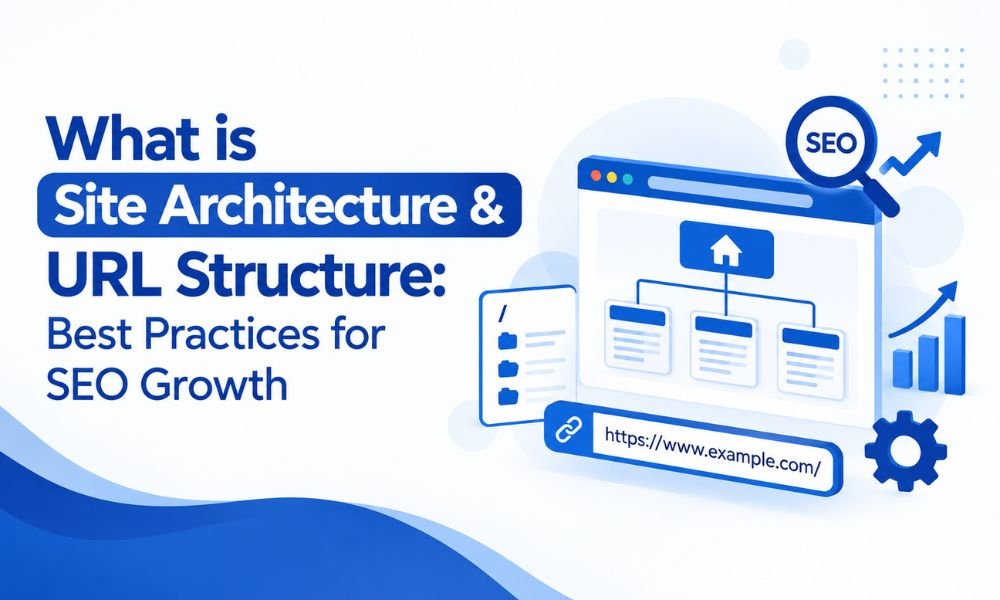
Site architecture refers to how the pages of a website are organized and connected to each other.
Think of your website as a hierarchy. The homepage is usually at the top, followed by major categories or service sections, with individual pages and articles underneath them.
For example:
Homepage → SEO Services → Technical SEO → Technical SEO Resources
This structure helps visitors find relevant information without unnecessary clicks. It also gives search engines contextual signals about how different pages relate to one another.
A good architecture should be:
- Logical and easy to understand
- Simple to navigate
- Organized around search intent
- Easy for search engine crawlers to access
- Scalable as the website grows
- Supported by relevant internal links
The goal is not simply to create fewer clicks. The goal is to create a structure where important pages are easy to discover and clearly connected to related content.
Why Site Architecture Matters for SEO
Site architecture influences several important areas of search performance.
1. Better Crawlability
Search engines use crawlers to discover and process website pages. A logical structure and strong internal linking help crawlers find important content efficiently.
If an important page is buried deep within the website and has very few internal links pointing toward it, search engines may have less context about its importance.
2. Improved Page Relationships
Internal links help establish relationships between pages.
For example, an article about technical SEO can naturally link to another resource covering Google Search Console. This creates a useful content relationship while helping both users and search engines discover relevant information.
3. Better User Experience
SEO is not only about search engines. Visitors should be able to understand where they are, what information is available, and where they should go next.
A clear navigation system reduces friction and makes it easier for users to move from informational content to relevant services or resources.
4. Stronger Internal Linking
Internal links distribute authority and provide contextual signals throughout a website.
Instead of randomly linking pages together, build topic clusters. A primary topic page can connect to supporting articles, while supporting articles can link back to the primary resource where appropriate.
For websites targeting competitive search queries, this organized approach can make the overall content ecosystem easier to understand.
Best Practices for SEO-Friendly URL Structure
Your URL structure should be simple, descriptive, and consistent.
For example:
Good:example.com/technical-seo/site-architecture/
Less useful:example.com/page?id=4587
A descriptive URL immediately gives users and search engines an idea of what the page covers.
Keep URLs Short and Descriptive
Avoid unnecessarily long URLs containing multiple keywords, dates, parameters, or irrelevant words.
Use the primary topic of the page instead.
For example:
/seo/site-architecture/
is clearer than:
/blog/2026/09/the-complete-ultimate-guide-to-understanding-site-architecture-and-url-structure-for-beginners/
Shorter URLs are easier to read, share, maintain, and understand.
Use Hyphens Between Words
Use hyphens to separate words in URLs.
For example:
/technical-seo-guide/
Avoid creating URLs with spaces, underscores, or complicated character combinations whenever possible.
Avoid Keyword Stuffing
Including the target keyword in a URL can be useful, but repeating keywords does not improve SEO.
A URL should describe the page naturally rather than attempting to manipulate rankings.
Use Lowercase URLs
Maintain consistency by using lowercase URLs. Mixing uppercase and lowercase versions can potentially create duplicate URL variations on systems where URLs are case-sensitive.
Build a Logical Website Hierarchy
A strong website hierarchy should reflect the way your audience searches for information.
For example, an SEO-focused website might use a structure such as:
SEO Services
→ Technical SEO
→ On-Page SEO
→ Local SEO
→ SEO Audits
Then supporting educational content can sit within relevant topic areas.
This approach makes it easier to create topic clusters and connect informational content with relevant commercial pages.
However, avoid creating unnecessary category levels simply to make the website look organized. Excessive hierarchy can make navigation complicated and increase the number of clicks required to reach important content.
Use Internal Links Strategically
Internal linking is one of the most practical ways to strengthen site architecture.
When writing an article, look for opportunities to link to other pages that genuinely help the reader.
For example, if you discuss technical SEO performance, you can naturally direct readers to a detailed resource on Google Search Console for technical SEO success.
Similarly, when discussing the importance of an optimized website structure for business growth, a relevant resource about SEO services for businesses can provide the next logical step for readers who want professional assistance.
The important point is relevance. Do not add internal links simply to increase the number of links on a page.
Create Topic Clusters
Topic clusters organize content around a central subject.
For example, a primary SEO guide could be supported by articles covering:
- Technical SEO
- Google Search Console
- URL optimization
- Internal linking
- Website crawlability
- Core updates
- SEO audits
- Local SEO
The main resource acts as a central hub, while supporting articles provide deeper information about specific subtopics.
This structure can help demonstrate topical depth while giving visitors multiple paths to discover useful information.
Keep Important Pages Close to the Homepage
Important pages should generally be easy to reach through your navigation and internal linking structure.
A page that requires many unnecessary clicks to discover may be less accessible to both users and crawlers.
This does not mean every page must be directly linked from the homepage. Instead, use a sensible hierarchy where important pages receive appropriate internal links from relevant high-value pages.
Review Your Architecture Regularly
Website architecture should not be treated as a one-time SEO task.
As your website grows, you may publish hundreds of articles, create new service pages, remove outdated content, or change categories. Over time, these changes can create orphan pages, broken links, redirects, duplicate content, and unnecessarily complicated navigation.
Regularly audit your website for:
- Broken internal links
- Orphan pages
- Duplicate or competing URLs
- Redirect chains
- Missing internal links
- Unnecessary URL parameters
- Pages buried too deeply in the hierarchy
- Outdated or thin content
Google Search Console and other technical SEO tools can help identify crawling, indexing, and search performance issues.
Final Thoughts
A successful SEO strategy starts with a website that search engines and users can understand.
A logical site architecture helps organize your content, while a clean URL structure makes individual pages easier to interpret. When combined with descriptive navigation, strategic internal linking, topic clusters, and regular technical audits, these elements create a stronger foundation for sustainable SEO growth.
The key is to build for people first and search engines second. Users should be able to find useful information quickly, while search engines should be able to crawl, understand, and connect your content efficiently.
As your website expands, continue reviewing your architecture rather than allowing pages and links to grow without a clear structure. A well-organized website is easier to maintain, easier to navigate, and better positioned to support long-term organic search visibility.