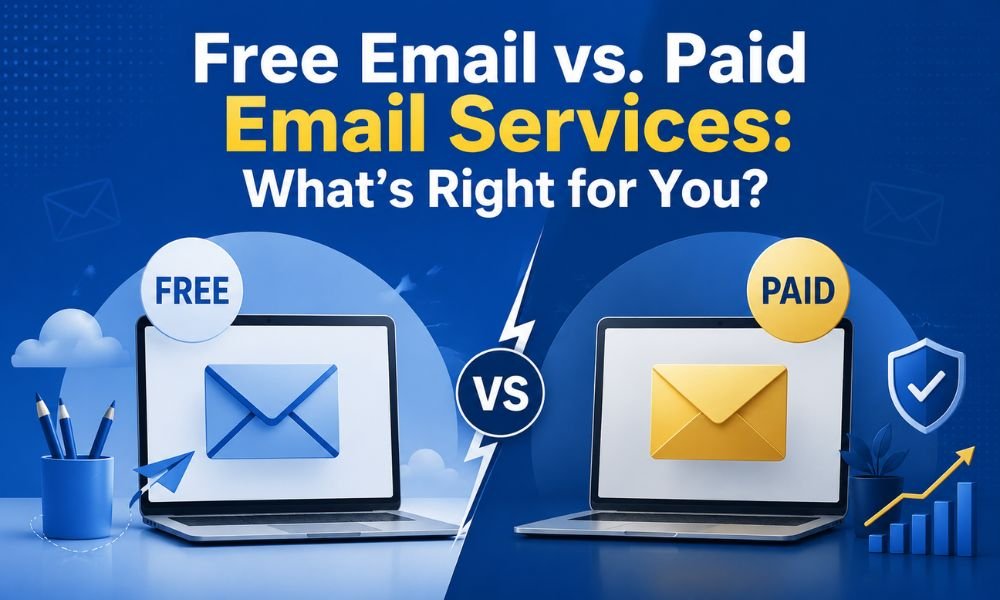
Choosing between free email and paid email services can seem simple at first. Free email accounts are easy to create, cost nothing, and are often enough for personal communication. But for businesses, marketers, startups, and growing teams, email is more than a way to send messages. It can influence brand credibility, customer trust, productivity, security, and email deliverability.
So, is free email or paid email better for your needs? The answer depends on how you use email, how much control you need, and whether email is an important part of your business operations.
This guide compares free and paid email services, explains their advantages and limitations, and helps you choose the right option based on your goals.
What Is a Free Email Service?
A free email service allows users to create and use an email account without paying a subscription fee. Popular providers offer webmail, mobile apps, spam filtering, storage, and basic security features.
For example, an individual may use an address such as yourname@gmail.com for personal communication, registrations, customer inquiries, or small-scale business activities.
Free email services are attractive because there is little financial commitment. You can create an account quickly and start sending and receiving emails without managing a mail server.
However, free accounts typically use the provider’s domain rather than your own business domain. That distinction becomes important as your company grows.
What Is a Paid Email Service?
Paid email services generally provide additional features, resources, support, administration, and customization in exchange for a recurring fee.
Depending on the provider, a paid service may allow you to use a professional domain such as name@yourbusiness.com. Business-focused platforms may also include larger storage limits, advanced security, centralized administration, collaboration tools, analytics, backup options, and technical support.
Paid email can also refer to professional email hosting or specialized email infrastructure designed for applications, transactional messages, or marketing campaigns. These services are different from ordinary inbox hosting and should be selected according to the type and volume of email you need to send.
Free Email vs. Paid Email: Key Differences
The biggest difference is not simply price. It is the level of control, professionalism, scalability, and support available to you.
1. Cost
Free email:
The biggest advantage is obvious: there is no subscription cost. This makes free accounts useful for students, freelancers, individuals, early-stage projects, and businesses testing an idea.
Paid email:
Paid services require a monthly or annual investment. However, the cost may be worthwhile when email directly supports sales, customer service, internal communication, or business operations.
If your email needs are basic, paying for features you never use may not make financial sense.
2. Professional Branding
A professional email address can make a meaningful difference in how customers perceive a company.
Compare:
yourcompany@gmail.comcontact@yourcompany.com
The second option communicates stronger brand ownership and can look more professional on websites, proposals, invoices, business cards, and marketing materials.
For companies that regularly communicate with customers or prospects, a branded email address is often worth the investment.
3. Storage and Features
Free services usually provide enough storage and functionality for everyday communication. But organizations may need more.
Paid plans can offer features such as:
- More mailbox storage
- Custom domain addresses
- Shared mailboxes
- Administrative controls
- Team collaboration
- Enhanced spam and phishing protection
- Advanced search and organization
- Business support
- Data management and security controls
Before purchasing a plan, identify the features your team actually needs instead of choosing the most expensive package automatically.
4. Security and Administration
Security is one of the strongest reasons businesses consider paid email.
Businesses may need centralized account management, stronger authentication controls, security policies, user provisioning, access management, and administrative visibility.
Free accounts can still provide strong baseline security, but business environments often require greater control over who can access accounts and how company information is handled.
Regardless of whether your email service is free or paid, practices such as strong passwords, multi-factor authentication, secure recovery methods, and regular account monitoring remain essential.
5. Scalability
A free account may work perfectly when you are working alone. But adding employees can make email management more complicated.
A growing business may need multiple addresses such as:
- sales@yourcompany.com
- support@yourcompany.com
- billing@yourcompany.com
- marketing@yourcompany.com
- hr@yourcompany.com
Paid business email makes it easier to manage accounts under a common domain and establish consistent communication across departments.
If your business is also planning marketing campaigns, choosing the right infrastructure becomes even more important. Businesses handling higher-volume email should understand the difference between ordinary mailbox services and dedicated email delivery systems.
6. Customer Support
With a free service, support may primarily come through online documentation, automated help, or community resources.
Paid plans may offer more direct support options, depending on the provider and subscription tier.
For a business that relies heavily on email, faster assistance can reduce downtime and help resolve account, configuration, or security problems more efficiently.
When Should You Choose Free Email?
Free email is usually appropriate when your requirements are straightforward.
Consider a free service if you:
- Need email primarily for personal use
- Are a student or individual user
- Run a very small side project
- Rarely send business correspondence
- Do not need a custom domain
- Want to minimize operating costs
- Need only basic inbox and messaging functionality
For many users, free email provides everything necessary.
If you’re specifically looking for no-cost options, exploring a selection of free email services for businesses can help you compare available choices before committing to a provider.
When Should You Choose Paid Email?
Paid email is generally a better choice when email represents your brand or plays a critical role in business operations.
You should consider paid email if you:
- Own an established business
- Want a custom domain
- Manage multiple employees
- Need centralized administration
- Require additional security controls
- Need business-grade support
- Want more storage and productivity features
- Need consistent branding
- Expect your communication requirements to grow
For businesses, the cost of professional email should be viewed as an operational expense rather than simply an added technology bill.
Free Email Is Not the Same as Free Email Marketing
One important distinction is between an email inbox and an email marketing platform.
A free Gmail, Outlook, or similar account is designed primarily for individual communication. It is not automatically suitable for sending large promotional campaigns.
Bulk marketing requires careful attention to permission, list quality, sender reputation, authentication, bounce rates, unsubscribe requirements, and deliverability.
If your objective is marketing rather than ordinary business communication, choosing an appropriate email marketing or SMTP solution is usually more practical than relying on a free mailbox.
For businesses evaluating delivery infrastructure, understanding SMTP ports and the differences between ports 25, 465, and 587 can also help when configuring email systems correctly.
How to Choose the Right Email Service
Before selecting a provider, ask yourself five questions:
1. Is this for personal or business communication?
Personal users may be perfectly comfortable with free email, while businesses often benefit from professional domain-based accounts.
2. Do I need a custom domain?
If branding matters, a paid business email service may be the better investment.
3. How many users will need accounts?
A single-user account has different requirements from a company managing dozens or hundreds of employees.
4. How important are security and administration?
Businesses handling sensitive customer or operational information should prioritize security and administrative controls.
5. Will my needs grow?
Choosing a solution that can scale can prevent unnecessary migration and disruption later.
Final Verdict: Free or Paid Email?
There is no universal winner in the free email vs. paid email services debate.
Free email is an excellent choice when you need a simple, convenient, and cost-effective communication tool. It can serve individuals, freelancers, students, and very small projects effectively.
Paid email becomes more valuable when professionalism, branding, administration, security, scalability, and support matter. For an established business, using a branded email address can strengthen credibility while giving the organization greater control over its communication environment.
The smartest approach is to match the service to your actual requirements. Don’t pay for advanced features you do not need—but don’t choose a free account simply because it costs nothing when your business has outgrown it.
In short: choose free email for simplicity and basic communication; choose paid email when your business needs professionalism, control, security, and room to grow.