Choosing an SMTP server in 2026 is no longer just about finding the lowest price per 1,000 emails. Businesses also need to consider deliverability, sending limits, dedicated IPs, analytics, authentication, support, scalability, and whether the provider charges a monthly subscription or a usage-based fee.
SMTP services help websites, SaaS platforms, e-commerce stores, applications, and businesses reliably deliver transactional and marketing emails. Depending on your sending volume and requirements, SMTP server costs can range from free plans to hundreds of dollars per month, while high-volume enterprise solutions may require custom pricing.
This guide explains how SMTP server pricing works in 2026, what businesses should budget for, and which costs are easy to overlook.
What Is an SMTP Server and Why Does It Cost Money?
SMTP, or Simple Mail Transfer Protocol, is the standard technology used to send email between servers. An SMTP service acts as the infrastructure between your website, application, or email platform and the recipient’s mail server.
Running a professional SMTP infrastructure involves much more than simply sending messages. Providers invest in:
- Mail transfer infrastructure
- IP addresses and IP reputation management
- Spam and abuse monitoring
- Email authentication
- Bounce and complaint processing
- Deliverability monitoring
- Analytics and reporting
- Redundancy and infrastructure security
- Technical support
For businesses, these services can reduce the risk of important emails being delayed, rejected, or sent to spam.
How Much Does an SMTP Server Cost in 2026?
There is no single SMTP server price because providers use different pricing models.
In 2026, common pricing structures include:
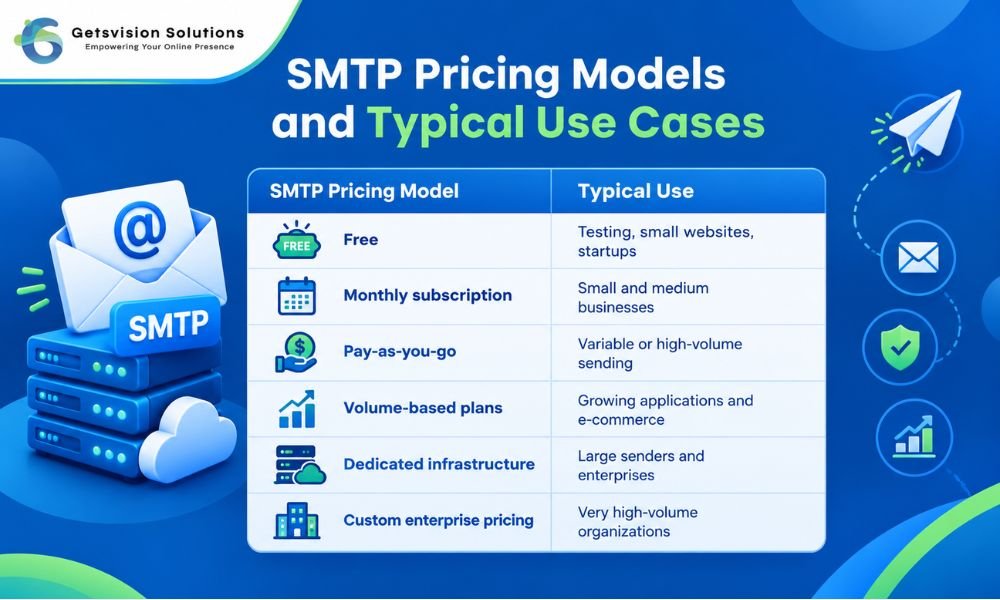
For example, Getsvision Solutions offers fixed monthly SMTP pricing based on email volume. Its plans start at $17.99/month for 25,000 emails, followed by $24.99/month for 50,000 emails, $39.99/month for 100,000 emails, $79.99/month for 300,000 emails, $109.99/month for 500,000 emails, and $159.99/month for 1 million emails. The plans include features such as a dedicated IP address, SPF, DKIM, DMARC, CMS and email-app integration, and customer support.
Meanwhile, Resend offers a free plan with 3,000 emails per month, a $20/month Pro plan with 50,000 emails, and a $90/month Scale plan with 100,000 emails.The difference demonstrates why businesses should compare the total cost at their actual monthly volume, rather than looking only at the advertised starting price.
SMTP Pricing Comparison in 2026
Several popular providers illustrate the range of available pricing models.
Getsvision Solutions
Getsvision Solutions SMTP Plans offers dedicated SMTP server plans with monthly email-volume packages. Its plans currently start at $17.99/month for 25,000 emails, with 50,000 emails at $24.99/month, 100,000 emails at $39.99/month, 300,000 emails at $79.99/month, 500,000 emails at $109.99/month, and 1 million emails at $159.99/month. The plans include SPF, DKIM, DMARC, CMS/email-app integration, a dedicated IP address, and phone, Skype, and email support. A 30-day trial is also advertised.
Amazon SES
Amazon SES is heavily usage-oriented. Its current à-la-carte outbound pricing is $0.10 per 1,000 emails, excluding additional charges such as attachment data and optional services. AWS also introduced Essentials, Pro, and Enterprise pricing plans in July 2026.
This model can be attractive to organizations that send large volumes and want infrastructure costs closely tied to usage.
Resend
Resend provides a free tier of 3,000 emails per month. Its Pro plan is currently $20/month for 50,000 emails, while the Scale plan is $90/month for 100,000 emails. Additional email usage is charged at $0.90 per 1,000 emails on paid plans.
Dedicated IPs are available as an add-on on eligible plans.
Postmark
Postmark’s current pricing starts with a free Developer option limited to 100 emails per month. Its Basic plan costs $15/month for 10,000 emails, Pro costs $16.50/month, and Platform costs $18/month. Additional emails are charged according to the selected tier.
Postmark also lists managed dedicated IPs starting at $50/month for customers sending at least 300,000 emails per month.
SMTP2GO
SMTP2GO currently provides a free plan for up to 1,000 emails per month. Its Starter plan is $10/month for 10,000 emails, while its Professional plan is $75/month for 100,000 emails. Higher-volume senders can request customized pricing.
Brevo
Brevo provides a free option with a 300-email-per-day sending limit. Its Starter plan begins at $9/month, while its Standard plan starts at $18/month. Higher-volume Professional plans currently start at $499/month and support substantially larger monthly sending volumes.
These examples show that SMTP pricing can vary significantly depending on whether you prioritize low per-email costs, an integrated marketing platform, developer-focused features, dedicated infrastructure, or advanced deliverability capabilities. Getsvision Solutions, for example, uses fixed monthly volume packages ranging from 25,000 to 1 million emails, with dedicated IPs and authentication features included in its listed plans.
What Determines Your SMTP Server Cost?
1. Monthly Email Volume
The number of emails you send is usually the biggest pricing factor.
A website sending 5,000 transactional emails per month has very different requirements from an e-commerce company sending 2 million order updates, notifications, and marketing emails.
Before choosing a plan, calculate your average monthly volume and your expected peak volume.
2. Transactional vs. Marketing Email
Transactional messages include:
- Password resets
- Account verification
- Order confirmations
- Shipping notifications
- Invoices
- Login alerts
Marketing emails include newsletters, promotions, product announcements, and campaigns.
Some providers combine both services, while others are optimized primarily for transactional delivery.
3. Dedicated IP Addresses
A dedicated IP can provide greater control over your sending reputation, but it adds cost and responsibility.
Not every business needs one. Smaller senders may be better served by a reputable shared infrastructure, while organizations with substantial and consistent sending volumes may consider dedicated IP infrastructure.
4. Deliverability Features
The cheapest SMTP service is not necessarily the lowest-cost solution if your emails frequently land in spam.
Businesses should examine features such as:
- SPF and DKIM authentication
- DMARC support
- Bounce handling
- Complaint management
- Suppression lists
- IP reputation monitoring
- Domain reputation monitoring
- Delivery analytics
For businesses concerned about inbox placement, understanding [email sender reputation] is an important part of evaluating the real value of an SMTP service.
5. Additional Features and Add-Ons
An SMTP provider may advertise an inexpensive base plan while charging separately for features such as:
- Dedicated IPs
- Email validation
- Advanced analytics
- Additional domains
- Extended data retention
- Priority support
- SSO
- Deliverability monitoring
Always calculate the final monthly bill based on the features your business actually requires.
How Much Should a Small Business Budget?
A small business sending between 5,000 and 50,000 emails per month may find that a budget of approximately $10–$50 per month covers basic SMTP requirements, although actual costs vary by provider and features.
For example, current plans from Resend, Postmark, SMTP2GO, and Brevo demonstrate that entry-level paid SMTP or transactional email services can begin below $20/month.
However, businesses should budget separately for domain authentication, email design, list cleaning, monitoring, and technical management when calculating their total email infrastructure costs.
What Should Growing Businesses Expect to Pay?
Companies sending 100,000 to 1 million emails per month should compare providers based on effective cost per 1,000 emails rather than simply comparing monthly subscription prices.
At this stage, deliverability becomes increasingly important. A small difference in SMTP pricing may be insignificant compared with the revenue impact of missed transactional messages or poor inbox placement.
For SaaS companies, e-commerce businesses, and online platforms, it is also worth comparing SMTP infrastructure with email APIs. The right architecture can make scaling and monitoring easier as email volume increases.
Is Cheap SMTP Always Better?
No. Price should be evaluated alongside reliability and deliverability.
A low-cost SMTP provider may be perfectly suitable for a small website that sends a few thousand messages every month. A larger business may require stronger analytics, dedicated infrastructure, multiple sending domains, advanced authentication, or specialized support.
Businesses should therefore ask:
- How many emails do we send each month?
- How quickly is our volume growing?
- Are our emails transactional, marketing, or both?
- Do we need a dedicated IP?
- What authentication features are included?
- What happens when we exceed our monthly quota?
- Are overages automatically charged?
- What support is included?
- Can the provider scale with us?
Hidden SMTP Costs Businesses Should Watch
The advertised monthly price isn’t always the final cost.
Watch for:
Overage charges: Some providers automatically charge for messages exceeding your plan.
Dedicated IP fees: Dedicated IPs can add a recurring monthly expense.
Email validation: Cleaning and validating large databases may cost extra.
Additional domains: Businesses managing multiple brands or customer accounts may need additional domain capacity.
Data and analytics: Longer message retention and advanced reporting can sometimes be paid add-ons.
Migration and setup: Switching SMTP providers may require developer time for DNS, SMTP credentials, application configuration, testing, and monitoring.
For this reason, the best way to calculate SMTP cost is to estimate your 12-month total cost of ownership, not simply the first month’s subscription.
How to Choose the Right SMTP Pricing Plan in 2026
Start with your monthly email volume and divide providers into three categories:
Small volume: Look for free or entry-level plans with reliable SMTP access and basic reporting.
Medium volume: Compare monthly quotas, overage pricing, analytics, authentication, and support.
High volume: Focus on effective cost per 1,000 emails, reputation controls, dedicated infrastructure, redundancy, and enterprise support.
Before switching providers, also verify your SPF, DKIM, and DMARC configuration. Authentication plays an important role in establishing sender legitimacy and supporting email deliverability.
Final Thoughts
SMTP server pricing in 2026 ranges from free plans for testing and small projects to usage-based pricing and customized enterprise contracts. Current provider pricing shows that businesses can find entry-level services for around $10–$20 per month, while high-volume requirements can move into hundreds or thousands of dollars depending on volume, infrastructure, and additional features.
The right SMTP budget depends on more than the number printed on a pricing page. Businesses should consider email volume, deliverability, authentication, dedicated IP requirements, analytics, overages, support, and future growth.
For companies comparing infrastructure options, reviewing the best SMTP providers for e-commerce can provide additional context before selecting a service.
Ultimately, an SMTP service should be evaluated as part of your broader email delivery infrastructure—not simply as another monthly software subscription.