For an e-commerce business, email is more than a marketing channel. It is part of the customer journey. Order confirmations, payment receipts, shipping updates, password resets, abandoned-cart messages, promotional campaigns, and delivery notifications all depend on reliable email infrastructure.
If these emails are delayed or sent to spam, customers may lose trust and businesses can miss sales opportunities.
That is why choosing the best SMTP service for e-commerce in 2026 requires more than comparing prices. E-commerce brands should consider deliverability, SMTP and API support, scalability, authentication, analytics, integrations, reputation management, and customer support.
Below, we compare 10 SMTP and transactional email providers and explain which type of e-commerce business each may suit.
What Should E-commerce Businesses Look for in an SMTP Service?
Before choosing an SMTP provider, consider these important factors:
- Deliverability: Your transactional emails should consistently reach customers’ inboxes.
- Scalability: The service should handle growth from thousands to millions of emails.
- SPF, DKIM, and DMARC: Proper authentication helps protect your sending domain and reputation.
- SMTP relay and API: Flexible integration is important for stores, applications, CRMs, and automation platforms.
- Analytics: Delivery, bounce, complaint, and engagement data help identify email problems.
- Dedicated IP options: These can be useful for businesses with sufficiently high and consistent sending volumes.
- WooCommerce, Shopify, and application compatibility: Integration should be straightforward.
- Support: Technical assistance can become particularly important when transactional emails stop sending.
For additional background, businesses can also review this guide to SMTP services for SaaS companies when comparing infrastructure requirements across different business models.
10 Best SMTP Services for E-commerce in 2026
1. Getsvision Solutions — E-commerce-Focused SMTP Infrastructure
Getsvision Solutions provides SMTP infrastructure designed for businesses that need transactional, bulk, and application email delivery.
Its SMTP services include dedicated infrastructure, SMTP relay and API integration, authentication support, monitoring, and scalable sending options. Its published plans range from 25,000 to 1 million emails per month and include features such as dedicated IP addresses and SPF, DKIM, and DMARC support.
For e-commerce businesses, SMTP infrastructure can be used for order confirmations, customer notifications, shipping updates, promotional communications, and other automated messages.
Best for: Indian e-commerce businesses, growing online stores, agencies, SaaS-enabled stores, and businesses looking for SMTP infrastructure with technical support.
2. Amazon SES — High-Volume E-commerce Email
Amazon Simple Email Service (SES) is a popular option for technically capable businesses that want scalable email infrastructure.
Its pay-as-you-go pricing can be particularly attractive at higher sending volumes. AWS currently lists outbound email at $0.10 per 1,000 emails under its à-la-carte pricing, although additional features and pricing plans can change the total cost.
The tradeoff is that businesses generally need more technical expertise to configure authentication, monitoring, bounce handling, templates, and deliverability workflows.
Best for: High-volume stores, AWS-based businesses, developers, and technically experienced teams.
3. Postmark — Transactional E-commerce Emails
Postmark focuses strongly on transactional email, making it relevant for messages such as order confirmations, receipts, account notifications, password resets, and shipping updates.
It offers SMTP and API-based sending and is designed around reliable transactional communication.
Best for: E-commerce stores where transactional messages are a critical part of the customer experience.
4. Resend — Modern Developer-Friendly Email
Resend has gained attention among developers because of its modern API and developer-oriented workflow.
It can be particularly useful for custom e-commerce applications and stores with development teams that want straightforward API-based email integration. Current 2026 pricing comparisons place its paid offering around the $20/month level for 50,000 emails, depending on the plan.
Best for: Custom e-commerce applications, startups, and developer-led teams.
5. Twilio SendGrid — Large E-commerce Ecosystem
Twilio SendGrid is an established email platform supporting SMTP relay, APIs, templates, analytics, and both transactional and marketing email.
Its current Email API pricing starts at $19.95/month for the Essentials plan, while the free option is a 60-day trial allowing 100 emails per day.
This makes SendGrid relevant for businesses that want transactional and marketing capabilities within a broader email platform.
Best for: Growing and established e-commerce brands requiring a mature email ecosystem.
6. Mailgun — Flexible Email APIs and SMTP
Mailgun is a developer-focused email delivery platform offering SMTP relay, APIs, webhooks, routing, logs, and other email infrastructure features.
For e-commerce businesses with custom applications, these capabilities can help developers build automated workflows around order processing, account management, customer notifications, and other events.
Best for: Developer-led stores, marketplaces, SaaS-powered commerce platforms, and custom applications.
7. Brevo — Marketing + Transactional Email
Brevo combines transactional email with marketing automation and customer-management features.
This can be useful for smaller e-commerce companies that want to manage promotional campaigns and transactional communications within one broader platform.
However, businesses should still maintain appropriate separation between promotional and critical transactional traffic.
Best for: Small and medium-sized e-commerce businesses wanting marketing and transactional functionality together.
8. SMTP2GO — Straightforward SMTP Relay
SMTP2GO focuses heavily on SMTP relay, monitoring, and email delivery infrastructure.
Its straightforward approach can appeal to businesses that want SMTP connectivity without building their own mail infrastructure. A recent 2026 comparison lists a 1,000-email monthly free allowance and paid plans starting at $15/month, although pricing and plan limits can change.
Best for: Businesses looking for SMTP relay, monitoring, and support.
9. MailerSend — Growing E-commerce Businesses
MailerSend offers transactional email through SMTP and API integrations, along with templates and webhooks.
It can work well for growing businesses that need more functionality than basic SMTP but do not want to manage their entire email infrastructure themselves.
Best for: Growing online stores, startups, and development teams.
10. Mailtrap — Testing and Development
Mailtrap is particularly useful for testing email workflows before they reach real customers.
For e-commerce development teams, testing order confirmations, password-reset messages, links, templates, and automated notifications in a controlled environment can help identify problems before production deployment.
Best for: Development teams, QA environments, staging, and businesses that prioritize email testing.
SMTP Comparison for E-commerce
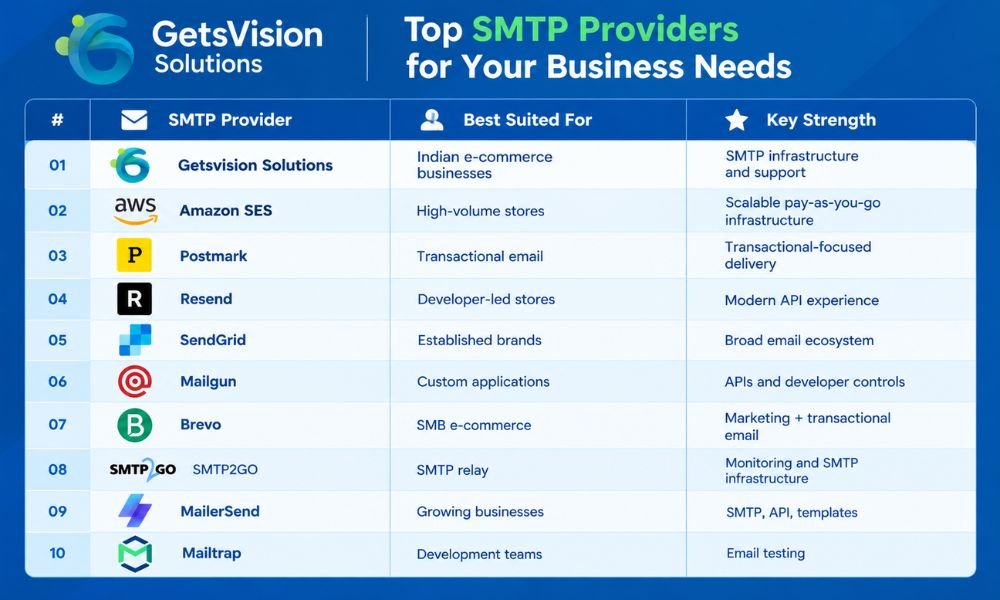
Pricing and features can change, so businesses should verify current plans directly with each provider before purchasing.
How to Improve E-commerce Email Deliverability
Choosing an SMTP provider is only one part of successful email delivery.
First, configure SPF, DKIM, and DMARC correctly for your sending domain. These authentication mechanisms help receiving mail systems verify that your messages are authorized.
Second, monitor your bounce rate, spam complaints, and sender reputation. Sending to outdated or invalid addresses can negatively affect your email program.
Third, separate transactional and promotional email where practical. A customer’s order confirmation should not depend on the same sending practices used for a large promotional campaign.
Finally, warm up new domains or dedicated IPs gradually when required and maintain good list-hygiene practices.
E-commerce stores using WooCommerce should also investigate their mail configuration if order notifications suddenly stop arriving. SMTP configuration can often resolve problems caused by unreliable default website mail functions.
Which SMTP Service Should an E-commerce Business Choose?
There is no single SMTP provider that fits every online store.
Getsvision Solutions can be considered by Indian e-commerce businesses looking for dedicated SMTP infrastructure, scalable sending options, authentication support, and technical assistance. Amazon SES is particularly relevant for businesses with AWS expertise and high sending volumes. Postmark is focused on transactional email, while Resend is designed around a modern developer experience.
SendGrid and Mailgun provide broader infrastructure for established and custom applications. Brevo is useful when marketing and transactional email need to coexist in one platform, while SMTP2GO offers a dedicated SMTP-relay approach. MailerSend and Mailtrap can be valuable for growing businesses and development workflows respectively.
The right choice ultimately depends on email volume, type of messages, technical resources, integrations, deliverability requirements, budget, and support expectations.
Before switching providers, calculate your monthly sending volume, identify your most important transactional emails, verify SPF/DKIM/DMARC configuration, and test actual inbox placement. The cheapest SMTP service is not necessarily the lowest-cost option if failed emails result in missed orders, customer complaints, or support tickets.